Author: Schatz Center

  • New Report: Offshore Wind Ratepayer Cost Analysis

    New Report: Offshore Wind Ratepayer Cost Analysis

    Our latest report estimates the ratepayer impacts over time associated with developing major new infrastructure – including a substation and two 500kV transmission lines – to enable offshore wind power from the Humboldt Wind Energy Area to reach the broader California electric grid.

    This analysis focuses on the two transmission projects approved by the California Independent System Operator (CAISO): (i) a new 500 kV substation, plus a transmission line connecting the Humboldt Bay region to the Collinsville substation (near Pittsburg), and (ii) a second 500 kV line, extending from Humboldt Bay to the Fern Road substation (northeast of Redding). These projects are currently scheduled to come online by the end of 2034. The sponsor (developer) for both projects is California Grid Holdings LLC, a subsidiary of Viridon Holdings LLC (Viridon).

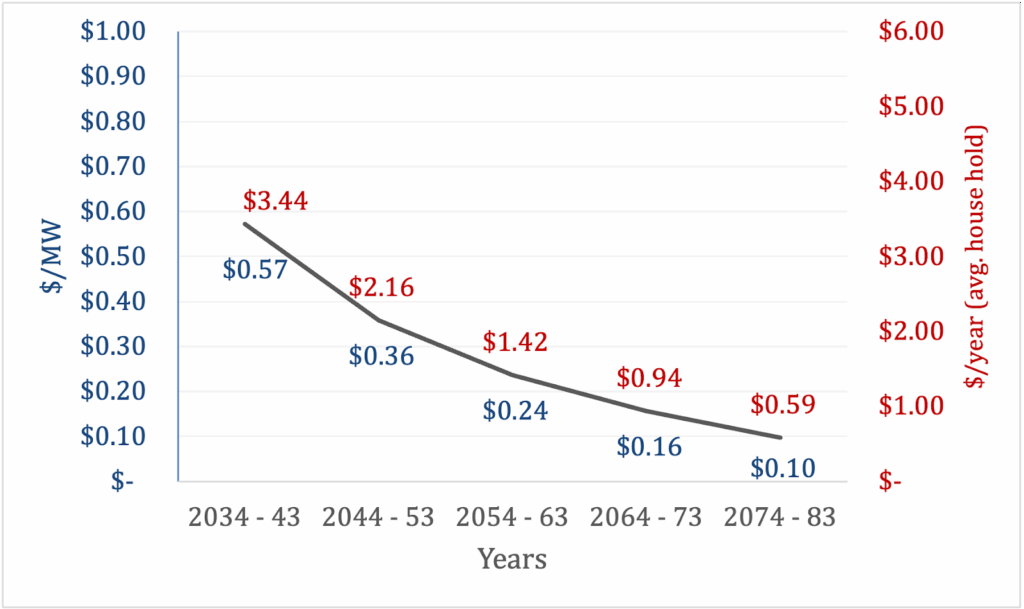
    Our findings show that Viridon’s recoverable costs, when spread across all customers on the CAISO-managed grid over the expected 50-year project lifetime, result in an estimated average cost to ratepayers of $0.28/MWh – or approximately $1.68 per year for the average California household (in 2025 dollars). 

    As shown below, ratepayer costs associated with this transmission development are expected to peak in 2035 (when the projects come online) at $0.75/MWh – $4.52/year for the average household – and decline steadily to $0.03/MWh by 2083.

    Line graph showing estimated ratepayer cost impacts over time in 2025 dollars using 10-year rolling averages. The x-axis displays five future time periods (2034–43, 2044–53, 2054–63, 2064–73, and 2074–83). The figure has two y-axes: the left y-axis shows cost per megawatt-hour in dollars ($/MWh), and the right y-axis shows the equivalent annual cost per average household in dollars per year. A single downward-sloping trend line indicates that ratepayer costs steadily decline over time. Values decrease from approximately $0.57/MWh (about $3.44 per household per year) in 2034–43 to about $0.10/MWh (about $0.59 per household per year) in 2074–83. Overall, the figure illustrates that the estimated cost impact to ratepayers decreases steadily over time

    Figure 1: Ratepayer impact over time in 2025 dollars (10-year rolling averages)

    Download the full report.

    Learn more about our offshore wind research.

    For more information, contact: schatzenergy@humboldt.edu or 707-826-4345. 

    Important note: The Schatz Center is committed to providing research that is accessible to everyone. If you encounter any barriers while using this document or require the information in an alternative format, please contact us at schatzenergy@humboldt.edu or 707-826-4345.

  • Coastal Community Perspectives on Offshore Wind: A Discussion of Emerging Themes

    Coastal Community Perspectives on Offshore Wind: A Discussion of Emerging Themes

    • When: Wednesday, January 14, from 5:30–7:30 pm (presentation will begin promptly at 5:30 pm; doors will open at 5:10 pm)
    • Where: Wharfinger Building, located at 1 Marina Way Eureka, CA 95501
    • Who: Everyone is invited to attend this free event!

    How are coastal community members thinking about offshore wind? What are the primary interests and concerns – and how do these vary within and between West Coast port towns? Are local residents engaging in “community benefit agreement” planning – and if so, how do they feel about these processes? Do residents have access to clear, accurate, and current information about wind development plans and opportunities within their own community?

    Over the past two years, researchers from Oregon State University (OSU), along with partners from the Schatz Energy Research Center at Cal Poly Humboldt, the University of Washington, the University of Delaware, and the University of Maine, have conducted a study on community perspectives on offshore wind development. On the West Coast, the team has interviewed and surveyed residents in three coastal communities – Humboldt Bay, California; Coos Bay, Oregon; and Westport, Washington – to better understand the emerging themes and differences along the coastal region.

    The community is invited to join the OSU and Schatz Center teams for a discussion of their preliminary findings, on Wednesday, January 14, from 5:30–7:30 pm at the Wharfinger Building in Eureka. Presenters will include Julia Bingham of Oregon State, and Tanner Etherton and Lauren Hart of the Schatz Center. The presentation will begin promptly at 5:30 pm; doors will open at 5:10 pm.

    This event is free and open to the public, and pizza and drinks will be provided. Please note that the discussion will not be filmed or live streamed, although a summary of findings will be available in mid-2026.  For questions or accessibility requests, please contact schatzenergy@humboldt.edu or call 707-826-4345.

  • Offshore Wind Jobs: Preparing Northern California Tribes and Local Communities (webinar)– Nov 12 @ 1 pm

    Offshore Wind Jobs: Preparing Northern California Tribes and Local Communities (webinar)– Nov 12 @ 1 pm

    REGISTER HERE

    Wednesday, November 12, 2025, 1:00 – 3:00 pm

    Join us for a discussion of current workforce development efforts to prepare Northern California Tribes and local communities for jobs in the offshore wind and related renewable energy sectors. Presentations will include findings from Humboldt County’s Offshore Wind Workforce Assessment, commissioned by the Humboldt County Workforce Development Board, a Board of the County of Economic Development Division, and from a recent Schatz Center report on professional labor demand in California’s floating offshore wind industry. Presenters will also highlight workforce development programs helping to prepare community members for offshore wind jobs, including the Ta’m Resiliency Campus at Blue Lake Rancheria and the Humboldt Multi-Craft Core Curriculum (MC3) Apprenticeship Readiness Program.

    Presenters:

    • Andy Logan, Head of Industry Development, US, Xodus – Humboldt County Offshore Wind Workforce Assessment
    • Tanner Etherton, Economic Analyst & Offshore Wind Extension Specialist, Schatz Energy Research Center, Cal Poly Humboldt – Professional Labor Report & POWC workforce initiatives
    • Heidi Moore-Guynup, Director of Tribal and Government Affairs, Blue Lake Rancheria – Ta’m Resiliency Campus and workforce development in renewable energy
    • Andie Rix, Workforce and Economic Development Specialist, University Advancement, Cal Poly Humboldt – Humboldt Multi-Craft Core Curriculum (MC3) Apprenticeship Readiness Program

    This talk is a production of the Pacific Offshore Wind Consortium. For more information on POWC, please visit powc.us.

    For questions about this webinar or to request technical or accessibility support, please contact schatzenergy@humboldt.edu or call 707-826-4345.

    About the POWC

    This webinar is being hosted by the Pacific Offshore Wind Consortium (POWC, pronounced pow-sea), which is a joint effort between three research centers: the Schatz Energy Research Center at Cal Poly Humboldt, the Pacific Marine Energy Center at Oregon State University, and the Center for Coastal Marine Sciences at Cal Poly San Luis Obispo. These universities are all housed in and supported by the coastal communities that are anticipated to host floating offshore wind development. Together, the consortium aims to advance three pillars: (i) research and innovation, (ii) university-level workforce education and professional development, and (iii) community and Tribal engagement and knowledge exchange. Learn more about the POWC here. 

    Additional resources

  • New report and upcoming lecture: Power Behind the Redwood Curtain

    New report and upcoming lecture: Power Behind the Redwood Curtain

    *Please note, this report has been updated as of Dec 2025.

    Save the date! Join us on Wednesday, October 29 from 5:30-7:00 pm in BSS 166 (next to the Native American Forum at Cal Poly Humboldt), for a presentation and discussion of this research. The event is free and open to the public. For questions or accessibility requests, please contact us at schatzenergy@humboldt.edu.


    A new report from the Schatz Energy Research Center provides a detailed historical account of the energy infrastructure that serves Humboldt County. Power Behind the Redwood Curtain: A History of Electric Transmission and Natural Gas Infrastructure in Humboldt County is written by Schatz Center director Arne Jacobson, and based on analysis of archival newspaper articles and documents, historic aerial photographs, and literature sources.

    Jacobson chronicles the close connection between Humboldt County’s existing energy infrastructure and the timber industry. His report then links that history with contemporary opportunities and challenges, ranging from regional economic development and electricity reliability to offshore wind deployment and the State of California’s climate and clean energy goals. 

    Electricity use in Humboldt County dates back to 1883, when power was first used to provide lighting at a lumber mill on Tuluwat Island in Humboldt Bay. While the use of electricity grew over the following decades, the architecture of the energy system that is in place today in the county was developed primarily in the two decades that followed World War II. During this period, the region’s timber industry grew rapidly in response to the nation’s post-war economic boom, and there was a corresponding expansion in the county’s electricity and natural gas infrastructure. Once this boom began to subside in the late 1960s, energy demand stagnated and investments in the energy system focused primarily on maintaining, rather than expanding, energy infrastructure serving the region.

    Today, the energy infrastructure that serves Humboldt County is small scale, aging, and fragile. The state of this infrastructure limits prospects for economic development and clean energy deployment in the county. It also undermines the livelihoods of people in some parts of the region, as they suffer from some of the least reliable electricity service in the state.

    Upgrading the region’s electrical infrastructure has become a point of interest for the State of California in the context of plans to develop offshore wind along the north coast. Wind farms offshore from Humboldt Bay have potential to contribute significantly to the state’s climate and clean energy goals, but the capacity of the existing transmission lines is much smaller than the scale of the proposed wind systems. In June of 2024, the California Independent System Operator (CAISO), which plays a leading role in electric transmission planning in the state, approved development of new transmission infrastructure with sufficient capacity to support large-scale offshore wind development in the Humboldt Wind Energy Area. The approved infrastructure was designed in a manner that could also help address some – albeit not all – of Humboldt County’s electric system capacity and reliability problems. However, development of the new infrastructure is not guaranteed. The current federal administration opposes offshore wind, and transmission projects generally face significant challenges with permitting and right-of-way acquisition. 

    As development of this new energy infrastructure is considered, it is crucial to have an understanding of how the proposed infrastructure fits into the history of prior investments in the county’s energy system. The “Power Behind the Redwood Curtain” provides context for the proposed transmission development and for other decisions related to the future of the Humboldt County energy system.

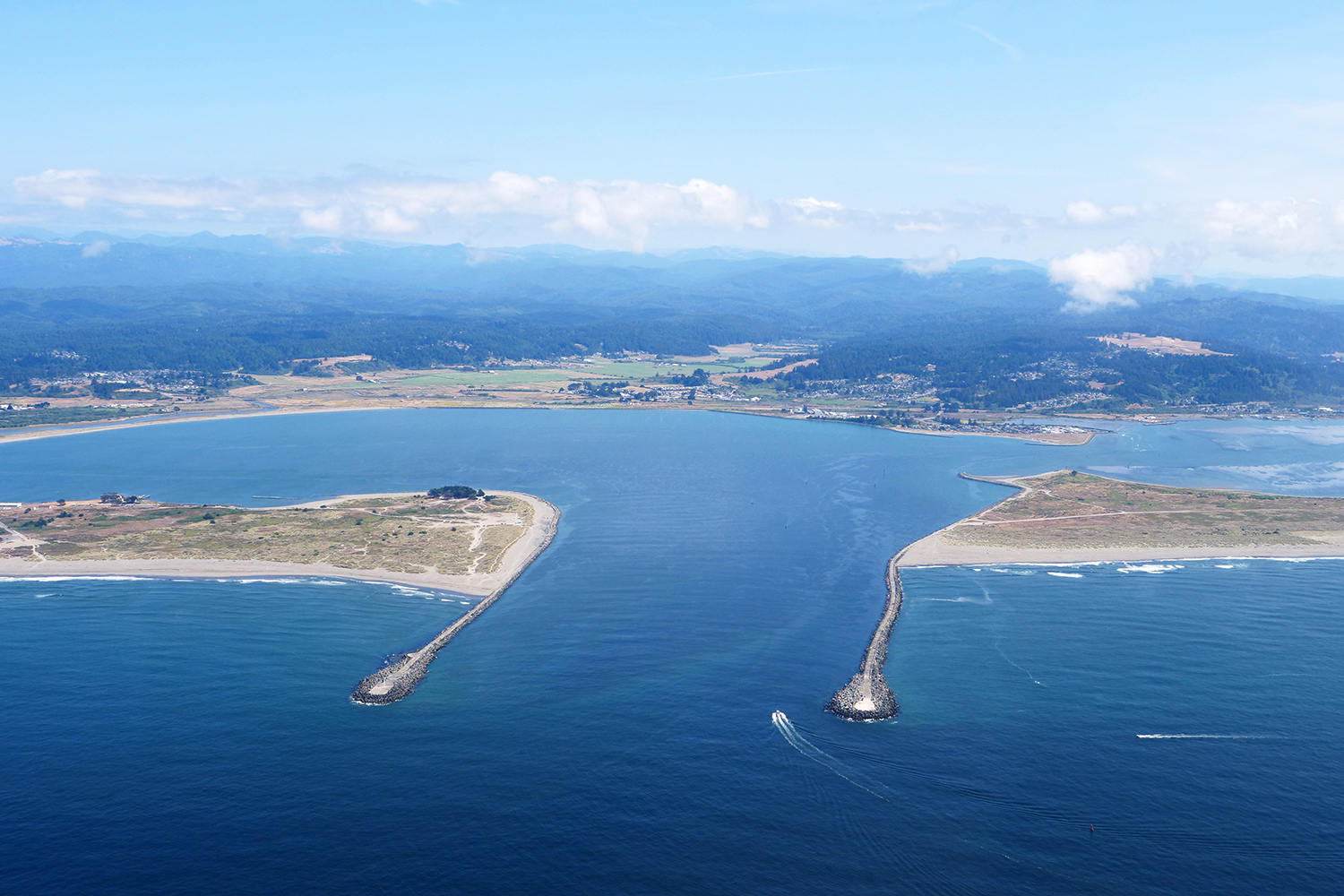
    Aerial photo shows generating station and transmission lines, across from the ocean entrance into Humboldt Bay
    Aerial photograph of the Humboldt Bay Generating Station. Source: Arne Jacobson. Photo date: February 11, 2024

  • Webinar: permitting for offshore wind port infrastructure projects- July 10 @ 2:30pm

    Webinar: permitting for offshore wind port infrastructure projects- July 10 @ 2:30pm

    UPDATE: 7/16/25


    REGISTER HERE

    Thursday, July 10, from 2:30-4:30 pm (PST) 

    For offshore wind energy projects to be developed in California, specialized port facilities—known as “staging and integration” sites—must be built to stage, assemble, and integrate massive floating offshore wind turbines before they are towed out to the designated offshore wind energy areas. This webinar will describe the key findings from our recently published report, Permitting for Port Infrastructure to Support Offshore Wind in California, and discuss permitting requirements for staging and integration sites, including those relating to Tribal consultation and public engagement. The presentation will be followed by a panel discussion with staff from the California State Lands Commission and California Coastal Commission to discuss each agency’s role in permitting these types of projects. 

    Panelists: 

    • Moderator: Awbrey Yost, Senior Policy Analyst, Schatz Energy Research Center
    • Amy Vierra, Renewable Energy Specialist, California State Lands Commission
    • Catherine Mitchell, North Coast Harbor Analyst, California Coastal Commission 
    • Dani Ziff, South Coast District Supervisor, California Coastal Commission

    REGISTER for this webinar

    About the POWC   

    This webinar is being hosted by the Pacific Offshore Wind Consortium (POWC, pronounced pow-sea), which is a joint effort between three research centers: the Schatz Energy Research Center at Cal Poly Humboldt, the Pacific Marine Energy Center at Oregon State University, and the Center for Coastal Marine Sciences at Cal Poly San Luis Obispo. These universities are all housed in and supported by the coastal communities that are anticipated to host floating offshore wind development. Together, the consortium aims to advance three pillars: (i) research and innovation, (ii) university-level workforce education and professional development, and (iii) community and Tribal engagement and knowledge exchange. Learn more about the POWC here. 

    Additional resources

    • If you’d like to receive emails about our offshore wind research and details on related webinars and presentations, please send us an email at windstudies@schatzcenter.org.
    • Learn more about our offshore wind research.

  • New Permitting Report for California Offshore Wind Port Development

    New Permitting Report for California Offshore Wind Port Development

    Our new report, Permitting for Port Infrastructure to Support Offshore Wind in California, identifies the numerous permitting and planning processes required to build port infrastructure that is necessary for offshore wind energy development in the state. 

    For offshore wind energy projects to be developed in California, specialized port facilities—known as “staging and integration” sites—must be built to stage, assemble, and integrate massive floating offshore wind turbines before they are towed out to the designated offshore wind energy areas. Because assembled turbines may float approximately 1,100 feet above the water, these port sites must be located in areas without height restrictions, such as bridges. As a result, very few suitable locations exist in California and permitting these staging and integration projects is complex. 

    Our report identifies the approximately 20 authorizations from federal, state, and local agencies that staging and integration project developers may need to obtain, and develops a potential permitting timeline based on existing statutory and regulatory deadlines. The report’s analysis applies statewide, but is also specifically applied to projects currently proposed in Wigi (Humboldt Bay) and the Port of Long Beach.  

    The report also provides an in-depth analysis of:

    • The key permitting processes and applicable standards for the environmental review that will holistically consider these projects–including those by the California Coastal Commission, ports and harbor districts, and the California State Lands Commission in some cases.
    • Recent legislation that aims to consolidate permitting for offshore wind energy projects and address the impact of these projects on fisheries. The report also identifies areas within these new laws needing clarification, particularly regarding agency responsibilities for issuing permits, Tribal consultation requirements, and compensatory mitigation for unavoidable impacts to fisheries.
    • The mandatory requirements for Tribal consultation and public engagement during the environmental review and key permitting processes for these projects. The report also analyzes recent state legislation aimed at creating more meaningful government-to-government consultation and a shared responsibility for resource management and conservation decisions within a Tribal Nation’s ancestral lands and waters.

    To read the full report and learn more about the permitting landscape for California’s offshore wind port infrastructure, visit schatzcenter.org/publications. For more information, contact: schatzenergy@humboldt.edu or 707-826-4345.


  • Final report: Evaluating seabird collision vulnerability to offshore wind development

    Final report: Evaluating seabird collision vulnerability to offshore wind development

    In 2020, our team began a collaboration with H. T. Harvey & Associates to understand seabird vulnerability to offshore wind within the marine waters off Southern California to Central Oregon.

    • H. T. Harvey & Associates led an effort to understand where seabirds have been observed, based on decades of existing data, and how those recorded species typically behave within the vertical air column in response to wind speed.
    • Simultaneously, the Schatz Center team analyzed wind speeds and associated power generation potential across the region – and then integrated the bird vulnerability framework with the wind power generation model.

    Our goal was to illuminate potential tradeoffs between collision vulnerability and offshore wind power generation, and to understand the likelihood of a given species to be within the strike-vulnerable zone of a rotating wind turbine. (Note: just as crossing a street is not equivalent to being hit by a car, assessing which birds may fly at heights within the rotor-swept zone of a wind turbine does not predict a number of strikes, but instead highlights a potential vulnerability for birds of that species. Future studies will examine seabird avoidance and attraction behaviors in response to turbine infrastructure.)

    For large floating offshore wind turbines such as those proposed for development along California’s Outer Continental Shelf, the base of the rotor-swept zone would be at least 25 meters above sea level. Our study uses a more conservative measure starting at 10 meters above sea level, which aligns with existing observational data. Our results indicate that for 44 species of seabirds found across the study area – from Point Conception, CA to Newport, OR – most are predicted to fly below 10 meters, with approximately 8% of the seabird community flying at or above 10 meters at any given time. These higher-flyers are dominated numerically by the seasonally abundant sooty shearwater, a dynamic-soaring species that uses high wind speeds to obtain high flight heights and soar for long distances, as well as several gull species.

    Our assessments encompassed all waters in the study area that are shallow enough to support floating OSW mooring infrastructure (1,300 meters or shallower). While multiple wind facility scenarios across a broad area of the West Coast were simulated for this report, the same framework can be utilized in the future to focus on new lease areas and other probable project locations as those become better refined.

    For more information, contact:

    Download the following reports from our publications archive:

    • Final report: Seabirds in 3D: A Framework to Evaluate Collision Vulnerability with Future Offshore Wind Developments
    • Interim Project Report 1: Estimating Collision Vulnerability of the Seabird Community Across a Segment of the California Current System 
    • Interim project report 2: Assessing Tradeoffs between Seabird Density at Collision Risk Height and Wind Facility Performance

    Funding:

    This research was funded by the California Energy Commission’s EPIC program. Learn more about EPIC.

  • New Labor Report for California Floating Offshore Wind

    New Labor Report for California Floating Offshore Wind

    Our new report, California Floating Offshore Wind: Evaluating Workforce Analyses and Assessing Professional Labor Needs, offers new insights into the professional workforce that will be needed in order to deploy floating offshore wind (FOSW) in California. The report (a) evaluates existing workforce analyses and tools, (b) examines key factors influencing job projections, and (c) assesses professional labor needs across multiple industry activities, including project development, supply chain, operations and maintenance, port development, and transmission infrastructure. In the context of this report, “professional occupations” refer to roles that typically require a university degree, and “professionals” are individuals in the workforce who hold such degrees.

    Existing analyses for the sector exhibit significant variability in job projections. For example, estimates for job creation by 2030 range from 2,375 to 8,280 jobs — with differences largely driven by assumptions regarding project scale and level of state participation in the supply chain. This report includes a sensitivity analysis of supply chain factors using the National Renewable Energy Laboratory’s Jobs and Economic Development Impact (JEDI) model. Our findings underscore the significant impact of in-state supply chain participation on overall job creation and workforce composition.

    Our analysis indicates that of the total jobs that could be created through the development of a 1.5 GW offshore wind project in the Humboldt Wind Energy Area, the manufacturing of components accounts for 60%; staging, assembly, and installation represent 10%; development and soft costs account for 11%; and less than 18% are in operations and maintenance. 

    The report’s evaluation of professional occupations across the FOSW sector, found that  professional occupations make up an estimated 37-41% of FOSW industry jobs (depending on the level of in-state supply chain activities), 20% of port development jobs, and 15% of onshore electric transmission development. In the FOSW industry, roles are concentrated in engineering, life and physical science, and management for many of the major activities.

    To assess workforce readiness, this report also examines how professional FOSW industry and port development occupations align with existing degree programs at Cal Poly Humboldt (CPH). Our review indicates that CPH currently offers programs that align with nearly all professional roles in the FOSW industry and port development, with particular strengths in engineering and environmental sciences. 

    • Download California Floating Offshore Wind: Evaluating Workforce Analyses and Assessing Professional Labor Needs from our publications archive.
    • For more information, contact: schatzenergy@humboldt.edu or 707-826-4345.
  • Offshore Grid Connection: Cable Laying and Monitoring (webinar)–May 12 @ 2 pm

    Offshore Grid Connection: Cable Laying and Monitoring (webinar)–May 12 @ 2 pm

    REGISTER HERE

    Monday, May 12, from 2-4 pm (PST) 

    PacWave is a state-of-the-art, pre-permitted, grid-connected, wave energy test facility that is being developed in partnership with the US Department of Energy, the State of Oregon, Oregon State University (OSU) and local stakeholders. The open ocean test site consists of four berths, which occupy two square nautical miles of ocean with a cable to shore of approximately 12 miles in length (for each berth). Drilling for cable conduits began in summer 2021 and cable laying was completed in fall 2024; however, permitting and cable procurement started long before that. This webinar will describe the cabling process, including pre-installation environmental surveys and post-installation monitoring.

    Presenters: Dan Hellin, the Director of the PacWave test facility and Sarah Henkel, the Associate Director of the Pacific Marine Energy Center at Oregon State University.

    For questions about this webinar or to request technical or accessibility support, please contact schatzenergy@humboldt.edu or call 707-826-4345.

    REGISTER for this webinar

    About the POWC

    This webinar is being hosted by the Pacific Offshore Wind Consortium (POWC, pronounced pow-sea), which is a joint effort between three research centers: the Schatz Energy Research Center at Cal Poly Humboldt, the Pacific Marine Energy Center at Oregon State University, and the Center for Coastal Marine Sciences at Cal Poly San Luis Obispo. These universities are all housed in and supported by the coastal communities that are anticipated to host floating offshore wind development. Together, the consortium aims to advance three pillars: (i) research and innovation, (ii) university-level workforce education and professional development, and (iii) community and Tribal engagement and knowledge exchange. Learn more about the POWC here. 

    Additional resources

    • If you’d like to receive emails about our offshore wind research and details on related webinars and presentations, please send us an email at windstudies@schatzcenter.org.
    • Learn more about our offshore wind research.
  • Humboldt Transit Authority Zero Emission Bus Project

    Humboldt Transit Authority Zero Emission Bus Project

    Responding to California’s Clean Transit Initiative, our local Humboldt Transit Authority (HTA) has begun a required transition to a zero-emission transit fleet. HTA will soon receive 11 New Flyer Xcelsior CHARGE FC™ fuel cell electric buses and construct a hydrogen fueling station on their corporation yard to fuel them. HTA will also work with the City of Eureka to construct the Eureka Regional Transit and Housing Center—the EaRTH Center—in downtown Eureka. The Schatz Center worked with HTA to submit the grant proposal that funded this project and will work as HTA’s owner’s engineer as the project progresses. California’s Transit and Intercity Rail Capital Program awarded HTA $39M for this work.

    New bus service is also part of the project. HTA is initiating a new service — the Redwood Express — from Eureka to Ukiah and back. The new service will allow transit riders to connect to Mendocino Transit and then on to the SMART train, connecting to San Francisco and other Bay Area locations. The route to Ukiah and back is an exceptionally demanding route for a 40-foot transit bus and existing fuel cell buses were unable to complete the route on one tank of hydrogen fuel. HTA and Schatz worked with New Flyer on a new bus design with a larger fuel cell, a larger battery, a more powerful traction motor, and additional fuel storage. This new bus has a 370-mile range and will comfortably make the Redwood Express run.

    HTA’s pilot fuel cell bus will arrive early in spring 2025 and be fueled at a temporary hydrogen fueler installed by Linde, an international gas supply company. The pilot bus will undergo an extensive testing program designed and overseen by the Schatz Center. Once certified, it will begin serving passengers on HTA’s Trinidad-to-Scotia and Redwood Express routes. The remaining 10 buses and the permanent hydrogen fueling station are planned for delivery and completion in 2026.