Join us for a public webinar on June 17, at 12:00 pm PST, to explore findings from this memo and learn more about the MoorSea project– an ongoing CEC-funded project related to sensor package development and detection of marine entanglements. Presenters will include Dr. Arne Jacobson, Dr. Maysam Mousaviraad, Eli Wallach, and Greyson Adams.
“Ghost gear” is the evocative term for lost, discarded and abandoned fishing gear found in the marine and coastal environment. This gear can create multiple hazards for marine life.
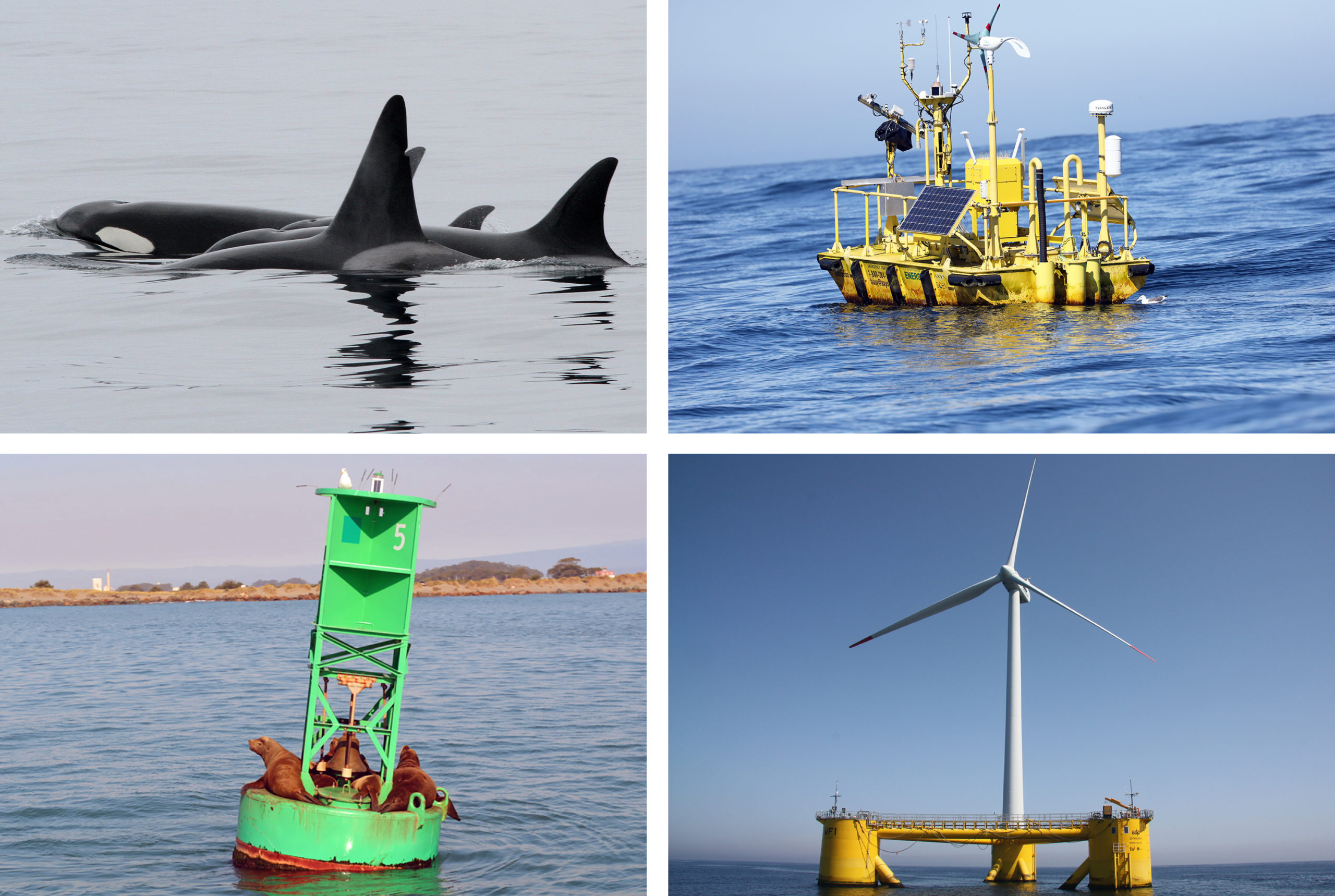
Secondary entanglement refers to situations where ghost gear becomes entangled with existing infrastructure – creating a new entanglement hazard. The Schatz Center is leading research efforts to support advancements in environmental monitoring for mooring lines used to anchor floating offshore wind farms. Our goal is to expand the capacity of underwater sensors and remote operated vehicles to detect (a) primary entanglements between ghost gear and mooring lines, and (b) secondary entanglements between mooring-line-entangled ghost gear and transiting marine species. Our study focus is the deepwater environment of the Humboldt and Morro Bay Wind Energy Areas (WEAs) off the coast of Northern and Central California.
In order to assess detectability, we first need to characterize: (i) species of concern within these areas, (ii) ghost gear found within this region, and (iii) the metocean environment within the WEAs. (Note: metocean data is key for evaluating the sensor-signal to background noise ratio.)
Our first report, prepared by the Schatz Center and our partner colleagues at H.T. Harvey & Associates for the MoorSEA project, provides a high-level overview of the environmental and biological data associated with the Humboldt and Morro Bay WEAs.
Learn more about our offshore wind research
For more information, contact: schatzenergy@humboldt.edu or 707-826-4345.
Important note: The Schatz Center is committed to providing research that is accessible to everyone. If you encounter any barriers while using this document or require the information in an alternative format, please contact us at schatzenergy@humboldt.edu or 707-826-4345.