Category: Research and program updates

  • Biomass Utilization Feasibility Study for the Karuk Tribe of California

    The Schatz Center is assisting the Karuk Community Development Corporation (KCDC) with a biomass utilization feasibility study. The Karuk Tribe of California (KTOC) has aboriginal territory encompassing the Klamath River and Salmon River watersheds in Northern California. These lands are heavily forested and have been adversely impacted by postcolonial land use practices like timber production and wildfire suppression. Large, destructive wildfires have become an annual occurrence in and around Karuk territory, and there is widespread agreement among land managers that forest practices in the region need to change. The KTOC is leading this change through eco-cultural revitalization efforts that involve putting beneficial fire back on the land and restoration of traditional oak woodlands. Within this context, there is a role for utilization of biomass residuals that are removed through mechanical treatment. The Schatz Center is evaluating economic development opportunities for the KCDC to utilize forest residuals.

    The overall goal of the project is to determine the feasibility of using local, renewable biomass resources that are available to the KTOC to generate power, heat, or products, while creating jobs, fostering environmental stewardship, and providing benefits to the Tribe’s economy. The objectives of this project are to determine the resource availability, identify technologies that could be implemented, and calculate the financial viability of potential projects.

    This project is currently active and is funded by US Department of Interior Indian Affairs Energy and Mineral Development Program. We expect to complete the project by the second quarter of 2018.

  • Improving a Biochar Production System in Mendocino County

    Improving a Biochar Production System in Mendocino County

    by Kyle Palmer and Mark Severy

    For the past three years, the Redwood Forest Foundation, Inc. (RFFI) has produced biochar from small-diameter tanoak trees collected from thinning operations in Mendocino County’s Usal Forest. The Usal Forest ecosystem was disrupted by industrial logging operations throughout the 20th century. Tanoak’s rapid regrowth dominated canopy light, and interfered with redwood repopulation. RFFI is selectively removing tanoak to create the natural space that redwood needs to flourish, and converting the tanoak into biochar to help fund their restoration work.

    Biochar, a blackened, solid biomass produced at temperatures above 500°C in the absence of oxygen, is used primarily as a soil amendment to increase water holding capacity, reduce nutrient leaching, and improve conditions for microbial life.

    RFFI’s biochar production operation has balanced on the edge of technical and economic feasibility due to the high moisture content of the tanoak feedstock and the labor costs required to operate the machine. In 2016, the Schatz Energy Research Center addressed moisture content by installing a biomass drying system that uses waste heat from the biochar machine. This year, the Schatz Center is working to reduce labor hours while improving safety and productivity, by automating key processes on the machine.

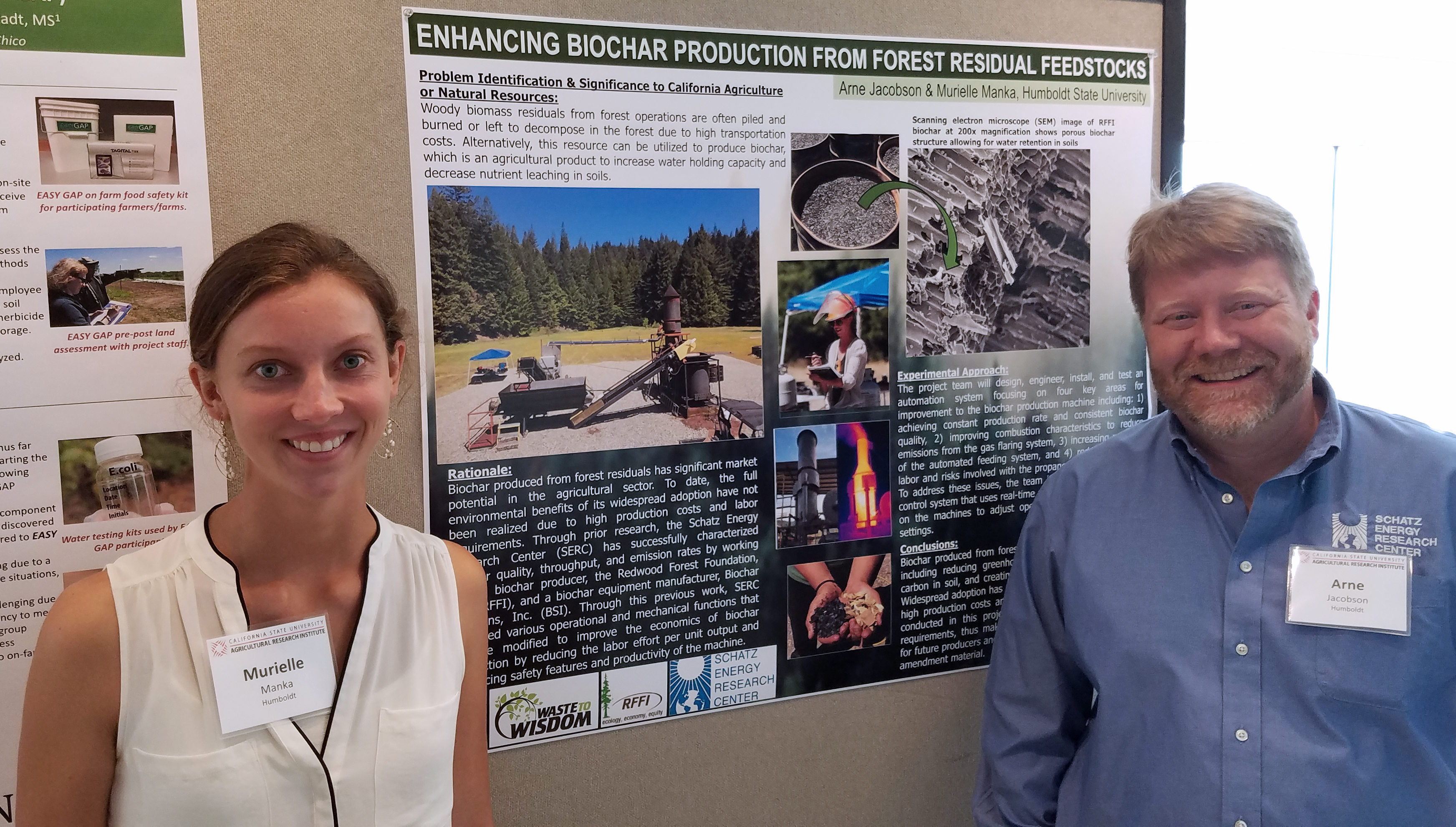
    In July and August, research engineers Kyle Palmer, Andy Eggink and student research assistant Murielle Manka evaluated baseline labor hours, biochar production rate, and biochar quality produced with the existing system. Throughout these tests, real-time data were collected for gas flow, composition, and electric power demand to help develop the control schemes. Monitoring and automation equipment are currently being installed and performance improvements will be validated in the coming months.

    The preliminary results from this study were presented in early September by Murielle Manka and Schatz Director Arne Jacobson at the Agricultural Research Institute’s (ARI) principal investigator’s meeting in Sacramento. Validation test results analyzed this autumn will quantify benefits of the automation system, including any reductions in labor, increases in throughput, and changes in biochar quality.

    This material is based upon work supported by California State University Agricultural Research Institute and a grant from the U.S. Department of Energy under the Biomass Research and Development Initiative program: Award Number DE-EE0006297.
  • Blue Lake Rancheria receives FEMA’s 2017 Whole Community Preparedness Award

    The Federal Emergency Management Agency (FEMA) announced on September 28 that the Blue Lake Rancheria Tribe (BLR) has been chosen to receive the 2017 John D. Solomon Whole Community Preparedness Award for proactive efforts to address emergency preparedness challenges. Arla Ramsey, Vice Chair of the Rancheria, lauded the tribe’s many collaborators in sustainability and disaster preparedness: “Our partnerships have been critical in our preparedness efforts, such as with the Schatz Energy Research Center, who led our low-carbon, community microgrid project and enabled our emergency power platform.”

    This award is given in recognition of the high earthquake risk faced by Humboldt County, and the BLR’s efforts to prepare for disaster events and ensuing power loss: “… BLR has transformed the Blue Lake Casino and Event Center into an official public shelter with help from the American Red Cross. BLR also installed a back-up green power micro grid should the regular power grid fail. Using a grant from the Department of Homeland Security, BLR developed a Regional Resilience Training & Innovation Center (RTIC) that offers pre-disaster training and exercises to tribes, local governments, and agencies. The tribe has also distributed 72-hour disaster supply backpacks to residents and employees, and in 2017 held a Resiliency Preparedness Fair for the general public. BLR’s actions have been a model for other tribes and communities, and BLR officials assist other tribes and agencies with their emergency preparedness needs.”

    Congratulations to the Rancheria for this much-deserved recognition of their commitment to emergency preparedness through disaster response training and sustainable, distributed energy generation!

  • Sustainable Futures Speaker Series: Amy & Daniel Cordalis on October 5

    Join us on Thursday, October 5 at 5:30 pm in Founders Hall 118, for a presentation by Amy & Daniel Cordalis on “Breathing life back into the Klamath River.”

    Amy Cordalis is General Counsel for the Yurok Tribe. She comes from a long line of Yurok Indians from the village of Requa at the mouth of the Klamath River, who have fought for Yurok rights: her great-uncle’s Supreme Court case, Mattz v. Arnett, confirmed the Yurok Reservation as Indian Country and set the stage for the Tribe’s federally reserved fishing and water rights. Cordalis received her undergraduate from the University of Oregon and her JD from the University of Denver College of Law. Before returning home to work for the Yurok Tribe in 2014, Cordalis worked for the Native American Rights Fund and Berkey Williams LLP on a wide range of Indian law issues.

    Daniel Cordalis is a member of the Navajo Nation and a practicing attorney in natural resources and Indian law. Cordalis clerked for the Colorado Supreme Court and the Native American Rights Fund, and worked for the National Congress of American Indians in Washington D.C. and as an associate attorney for the Denver Earthjustice office. He received an undergraduate in geology from Rice University, a master’s in geography from the University of Colorado at Boulder, and his JD from the University of Colorado.

    The Sustainable Futures Speaker Series is cosponsored by the Schatz Energy Research Center, the Environment & Community graduate program, and the College of Arts, Humanities and Social Sciences at Humboldt State. For details on upcoming events or to request accessibility accommodations, email us at serc@humboldt.edu or call (707) 826-4345.

  • Sustainable Futures Speaker Series: Nick Goulette on September 28

    Join us on Thursday, September 28 at 5:30 pm in Founders Hall 118, for a presentation by Nick Goulette on imagining and achieving the potential of community-based forestry in Northern California. As The Watershed Center’s executive director, Nick Goulette oversees programs focused on forestry, fire and fuels, watershed and fisheries, youth engagement, enterprise development, policy, and research.

    Over the past thirteen years with the Watershed Center, Goulette has worked on a wide range of collaborative projects. He is the Chair of the Northern CA Prescribed Fire Council and a long-time member of the leadership team for the Rural Voices for Conservation Coalition. He also helped establish the CA Forest Biomass Working Group and the CA Statewide Wood Energy Team, and worked with the design and launch of the national Fire Adapted Communities Learning Network.

    Goulette was born and raised in Maine and received a B.S. in Forestry from the University of Vermont with a concentration in Community-Based Forestry. He now lives with his wife Naomi on a homestead in Weaverville, California.

    The Sustainable Futures Speaker Series is cosponsored by the Schatz Energy Research Center, the Environment & Community graduate program, and the College of Arts, Humanities and Social Sciences at Humboldt State. For details on upcoming events or to request accessibility accommodations, email us at serc@humboldt.edu or call (707) 826-4345.

  • Sustainable Futures Speaker Series: Debbie Page-Dumroese on August 31

    Join us on Thursday, August 31 at 5:30 pm in Founders Hall 118, for a presentation by visiting soil scientist Debbie Page-Dumroese on the use of biochar to sequester carbon and improve soil resilience. Biochar is a porous, high-carbon material derived from exposing biomass to temperatures above 500°C in a low-oxygen environment. The resultant “char” is typically used as a soil amendment to increase water-holding capacity and nutrient retention.

    Page-Dumroese has been a Research Soil Scientist with the USDA Forest Service Rocky Mountain Research Station for over three decades. Her work focuses on long-term soil productivity after harvest operation, sustainable harvesting, wood decomposition, and biochar. For the last ten years, she has been investigating the potential to reduce slash pile burns and limit wildfire risks by using onsite biochar conversion technologies.

    The Sustainable Futures Speaker Series is cosponsored by the Schatz Energy Research Center and HSU’s Environment & Community graduate program. For details on upcoming events or to request accessibility accommodations, email us at serc@humboldt.edu or call (707) 826-4345.

  • SERC and solar power in sub-Saharan Africa

    In this week’s New Yorker magazine (issue: June 26, 2017), Bill McKibben reports on solar power development in sub-Saharan Africa, including the role of quality assurance testing offered by SERC and other labs in the Lighting Global network.

    Clarification (for the New Yorker piece): SERC Director Dr. Arne Jacobson played a leading role in the creation and implementation of Lighting Global, a program jointly managed by the International Finance Corporation and World Bank. The international testing labs are part of the Lighting Global network, not subsidiaries of the Schatz Energy Research Center (SERC). SERC provides setup and training for Lighting Global affiliated labs in Africa and Asia, as well as off-grid product testing and standards development.

  • Report from the annual Waste to Wisdom meeting

    Report from the annual Waste to Wisdom meeting

    SERC presented at the Waste to Wisdom annual meeting in Sacramento on May 17th. This public meeting brought together over one hundred academics, policymakers, project developers, community members, and equipment manufacturers from around the country to discuss the opportunities and challenges to increasing utilization of forest residues.

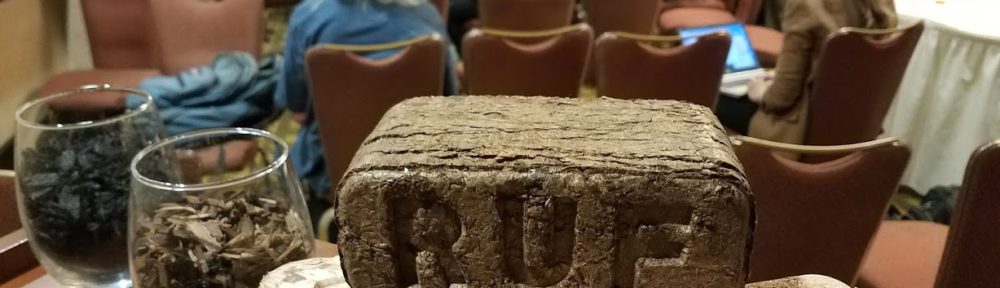
    Arne Jacobson, David Carter, and Mark Severy presented on Biomass Conversion Technologies: System Performance, Case Studies, and Implications for California’s Forest Management. Using examples from our research, SERC engineers described the state of biomass conversion technologies with a focus on biochar, torrefied biomass, and densified briquette production. Our presentation hinged around identifying and discussing methods for overcoming the current challenges of scale, site infrastructure, feedstock quality, environmental safety, and market development that are holding back widespread adoption of these biomass conversion technologies.

  • A Message from the Director

    As we move into autumn, I would like to take time to thank the SERC team and our many excellent project partners. We are in the midst of one of the busiest and most productive years in our history. The successes we have had are a result of the hard and good work of our stellar team and our collaborators.

    Over the past year we have worked on over 20 projects involving more than 60 collaborators. This work spans four continents, including efforts in Africa (Kenya, Tanzania, Ethiopia, Uganda, and Nigeria), Asia (India, Bangladesh, Pakistan, Myanmar, and China), Europe (UK, Netherlands, and Germany), and North America (USA). While I cannot thank each of our partners by name, several deserve special mention, including the Redwood Coast Energy Authority, the Blue Lake Rancheria, Siemens, Pacific Gas and Electric, Idaho National Laboratory, Lawrence Berkeley National Laboratory, Global LEAP, everyone from the BRDI/Waste to Wisdom team, and colleagues from the World Bank Group’s Lighting Global, Lighting Africa, and Lighting Asia programs.

    As you can imagine, our team has been very busy. While everyone has pulled their weight and more, special thanks are due in several areas. First, our operations and administrative team, led by Allison Hansberry, has worked tirelessly to keep everything moving forward effectively. I give my sincere gratitude for their efforts and good work. Second, SERC’s project managers have managed substantial responsibility with grace and poise. Dave Carter, Jim Zoellick, Jerome Carman, and Meg Harper merit special thanks for carrying heavy project management loads in difficult circumstances. Third, Steve Karp and his team at the Humboldt State University Sponsored Programs Foundation deserve credit for all the support they provide during both the pre- and post-award periods. We all appreciate their efforts; we could not succeed without them. Fourth, the SERC Advisory Board has helped us immensely through input that ranges from strategic guidance to networking support. Their assistance has been invaluable. Fifth, I want to thank everyone on the SERC team who has stepped up and helped with fundraising and proposal writing over the past few months, despite all the other work on their collective plates. While many have contributed, several people in particular have played leadership roles in this push, including Peter Lehman, Kevin Fingerman, Jim Zoellick, Jerome Carman, Meg Harper, Richa Goyal, and Mark Severy. I also want to thank all of the agencies that have supported our work over the past year. Here, the California Energy Commission, International Finance Corporation, World Bank, and U.S. Department of Energy merit special mention for being among our leading funders.

    I will close with some staff transitions. First, I am pleased to welcome our new faculty members; Peter Alstone and Liza Boyle joined us in August. Peter has a joint appointment between SERC and the Environmental Resources Engineering (ERE) Department, while Liza is a Faculty Research Associate at SERC and a member of the ERE Department. Both are already engaged in activities at SERC, and we look forward to much more of their involvement going forward. I am also pleased to welcome Scott Toyama, Jimento Aikhuele, and Steve Shoemaker to the SERC team. Scott joined in May as a full-time engineering technician in our off-grid solar laboratory. Jimento and Steve are incoming graduate students in the Energy Technology and Policy (ETaP) master’s program. Jimento is this year’s recipient of the Schatz Energy Fellowship, while Steve is the first recipient of the Blue Lake Rancheria Fellowship for Clean Energy Studies. It is great to have them both on board (and thank you again to the Blue Lake Rancheria Tribe for establishing the fellowship).

    Last, but certainly not least, I want to thank people who have moved on from SERC to other endeavors. These include Malini Kannan, Janoah Osborne, Ga Rick Lee, Greg Pfotenhauer, and Lukas Kennedy; they each made great contributions over the past few years to SERC’s work related to off-grid solar, clean transportation, and/or biomass energy. I am also grateful to Asif Hassan, Jayati Thakor, Steve Harrison, Emily Klee, and Rich Williams, all of whom worked for us as students, for their efforts on projects related to off-grid energy access and biomass energy. Richa Goyal, who has been with us at SERC as a visiting scholar for the past year and a half, has moved back to India. Fortunately for us, she will continue to work with us as a consultant going forward. Finally, a very special thank you is due to Mark Rocheleau, who retired from SERC in June after 24 years of dedicated service. All of these good people are greatly missed, but we are excited about all the good things that they are doing out in the world.

    Goodbye until next time.