Author: Dave Carter

  • Technical Update: Redwood Coast Airport Renewable Energy Microgrid

    Technical Update: Redwood Coast Airport Renewable Energy Microgrid

    This fall, we have been working on project initiation tasks in advance of our technical team kickoff in early 2019. Here are some of the highlights:

    1. The contract with our major partner, the Redwood Coast Energy Authority (RCEA), is completed and approved by the RCEA Board of Directors. We also have completed contracts with TRC Solutions and Schweitzer Engineering Laboratories.
    2. We are in the late stages of procurement contracting for the 2 MW photovoltaic array and the 8 MWh battery energy storage system.
    3. We are working on a Memorandum of Understanding between the Schatz Center, RCEA, and the County of Humboldt to solidify the roles and responsibilities of each organization during the project implementation process.
    4. We are continuing to work through the final approval process with the Federal Aviation Administration to site the microgrid on airport property.
    5. RCEA will be utilizing a loan from US Department of Agriculture’s Rural Utilities Service to provide much of their cost share for the project. We are working with RCEA to complete the application process for the loan.
    6. We are ramping up our work with Pacific Gas & Electric’s (PG&E) project team in preparation for tariff development work, engineering design, and lab testing activities scheduled for 2019.

    By March of 2019, we will have all of our contracts in place and will be underway with our electrical design, preparing an interconnection application with PG&E, working with TRC on business model evaluation and cybersecurity planning, and beginning tariff development work with RCEA and PG&E.

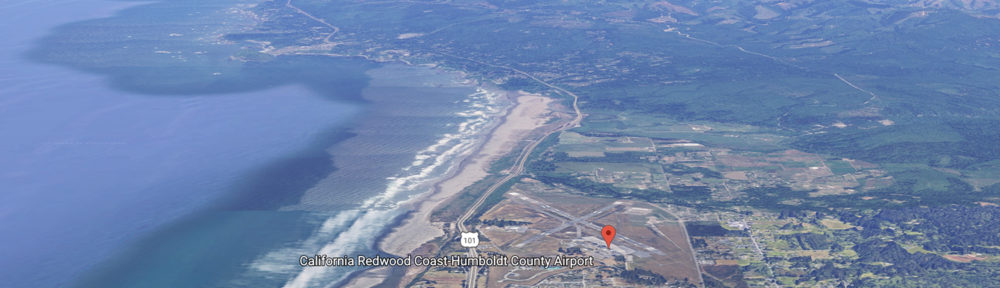
    The Redwood Coast Airport Renewable Energy Microgrid is funded by a $5 million grant from the California Energy Commission’s Electric Program Investment Charge and a $6 million match from the Redwood Coast Energy Authority. During an energy outage, the microgrid’s controller will use the 2 MW photovoltaic array and 8 MWh battery to form an electrical island to maintain power for the airport and the adjoining U.S. Coast Guard Air Station. The solar electric system in the microgrid is expected to generate over 3,100 MWh of electricity per year, with most of the energy going to RCEA’s Community Choice Energy Customers through the CAISO wholesale market. A portion of that renewable electricity will be credited directly to the airport’s electricity meters, offsetting approximately 80% of the electrical usage of their two largest electricity accounts. This system will be the first multi-customer, front-of-the-meter microgrid in PG&E’s service territory. It will integrate a microgrid circuit owned by an investor-owned utility (PG&E) with generation owned by a local community choice aggregator (RCEA).

  • Microgrid Feasibility Study for UCSC

    The Schatz Center is working with GHD, an international engineering firm, to conduct a microgrid feasibility study for the University of California, Santa Cruz (UCSC). The study is focused on a former semi-conductor manufacturing facility that was acquired by UCSC and is being converted to offices and research lab space. UCSC wants to install a microgrid with renewable energy generating capacity of 2 to 4 Megawatts, allowing the facility to island and operate independently of the Pacific Gas & Electric grid as well as parallel with and provide support to PG&E’s grid in Santa Cruz. Another important objective is to use the microgrid as a teaching and learning laboratory by including both commercially mature and emerging/experimental technologies as well as advanced supervisory control and data acquisition systems.

    The study includes:

    • evaluating microgrid technologies,
    • assessing space requirements for generation and storage technologies,
    • developing a design load profile for full occupancy,
    • selection of recommended technologies,
    • developing a site plan and one line diagram,
    • estimating construction costs,
    • evaluating interconnection requirements/constraints,
    • developing an implementation plan including potential funding sources,
    • identifying educational curriculum opportunities, and
    • evaluating how to connect the facility with the adjacent UCSC Coastal Sciences Campus to create one large microgrid that could support both of these facilities.

    This project is currently active and scheduled to be completed by the end of 2017. The project is funded by the UC Regents.

  • Biomass Utilization Feasibility Study for the Karuk Tribe of California

    The Schatz Center is assisting the Karuk Community Development Corporation (KCDC) with a biomass utilization feasibility study. The Karuk Tribe of California (KTOC) has aboriginal territory encompassing the Klamath River and Salmon River watersheds in Northern California. These lands are heavily forested and have been adversely impacted by postcolonial land use practices like timber production and wildfire suppression. Large, destructive wildfires have become an annual occurrence in and around Karuk territory, and there is widespread agreement among land managers that forest practices in the region need to change. The KTOC is leading this change through eco-cultural revitalization efforts that involve putting beneficial fire back on the land and restoration of traditional oak woodlands. Within this context, there is a role for utilization of biomass residuals that are removed through mechanical treatment. The Schatz Center is evaluating economic development opportunities for the KCDC to utilize forest residuals.

    The overall goal of the project is to determine the feasibility of using local, renewable biomass resources that are available to the KTOC to generate power, heat, or products, while creating jobs, fostering environmental stewardship, and providing benefits to the Tribe’s economy. The objectives of this project are to determine the resource availability, identify technologies that could be implemented, and calculate the financial viability of potential projects.

    This project is currently active and is funded by US Department of Interior Indian Affairs Energy and Mineral Development Program. We expect to complete the project by the second quarter of 2018.